Can AI Build an Android App in India? My Real 2026 Cost Test
I kept seeing the same promise online: build an app with AI, publish it, and watch the money arrive.
That sounded great. It also sounded like the kind of sentence that makes a developer check their bank account twice. So I ran a more honest experiment: what does it actually take to build and launch an Android app for India in 2026?
The short answer is simple. AI can make the first version much faster. It cannot remove store rules, testing, design decisions, user support, or the bill.

AI shortens the distance from idea to testable build. The launch work still matters.
Why India—and why an AI Android app now?
India is one of the clearest places to test this idea. Sensor Tower reported 6.2 billion app downloads in Q1 2026, while estimated in-app purchase revenue passed $300 million. Generative-AI app downloads grew 69% year over year, and non-gaming apps generated most of the download volume.
Google’s India Year in Search also showed that AI had moved into everyday curiosity and work. Searches extended well beyond one product to Gemini, ChatGPT, DeepSeek, Perplexity, Google AI Studio, and other creation tools.
Those numbers reveal demand, but they do not guarantee installs for a new app. The practical opportunity is narrower:
- Utilities and productivity already have scale. They represented more than one-third of India’s installs in 2025.
- AI-powered services are still growing. A focused tool can ride that interest without pretending to be an all-purpose assistant.
- Retention matters more than a launch spike. India’s market is moving from pure download scale toward repeat use and monetization.
What I actually paid for

The code may start cheaply; testing, store access, design, and support form the real cost.
The hard cash requirement can be small. Google currently lists a US$25 one-time registration fee for a full Google Play developer account. The first prototype can use free tiers, but “free to prototype” is not the same as “free to run.”
I counted four cost buckets:
- Build tools: AI coding assistance, design tools, APIs, hosting, and analytics after free limits are reached.
- Publishing: the Play Console account, identity verification, store graphics, a privacy page, and any business setup that applies to the developer.
- Testing: real Android devices, different screen sizes, slow-network checks, crashes, and the time needed to fix them.
- Operations: support email, updates, moderation, API usage, and the inevitable “it worked on my phone” problem.
For a first experiment, I would keep the stack boring: one Android app, one clear use case, and the smallest useful set of AI services. The goal is to learn what users do, not to build a platform before the first install.
The Android build was only the middle
A browser prototype can feel finished long before a store build is ready. The Android version forced me to check permissions, offline behavior, loading states, accessibility, and the parts of the interface that looked fine only on my own screen.
Before publishing, I would require this minimum checklist:
- The first useful action is obvious within seconds.
- The app explains why every sensitive permission is needed.
- Loading, empty, offline, and error states are usable.
- The store screenshots match the actual product.
- The privacy policy and data-safety answers match the code.
- Analytics measure activation and return visits—not just downloads.

Ads, one-time upgrades, and subscriptions solve different business problems.
Where the money could come from
For a small Android app in India, I would test monetization in this order:
- A useful free experience with restrained ads. Ads fit broad, frequent usage, but a badly placed ad can destroy the task that brought the user in.
- A one-time paid upgrade. This works when the value is clear: remove limits, export results, unlock a tool, or eliminate ads.
- A subscription only for recurring value. Cloud processing, fresh content, monitoring, or continuous AI assistance may justify it. A static utility usually does not.
India can deliver serious reach, but reach is not revenue. Local pricing, retention, app quality, and trust matter more than a dramatic download screenshot. My first commercial target would be finding the feature that brings a second session, then improving it before buying traffic.

The first traffic loop: answer a real question, earn a visit, collect feedback, and improve the app.
How I would get the first users
I would not begin with a broad keyword such as “best AI app.” The first content cluster would answer specific searches from people close to taking action:
- how to build an Android app with AI in India
- Google Play app publishing cost in India
- AI app monetization for Indian developers
- how to test an Android app before Play Store release
- best pricing model for a small utility app
Each post would solve one problem, show original screenshots or build evidence, and point to the next relevant guide. Short videos can demonstrate the result, while developer communities can supply the questions that become future articles.
The first users should be treated like testers, not numbers. I would ask where they stopped, what they expected, and whether the app saved enough time to open again. That feedback becomes both product work and search content.
The honest result
AI did not turn this into a passive-income machine. It did make the distance between an idea and a testable Android build much shorter. That is the useful opportunity: cheaper experiments, faster feedback, and a better chance of finding one small app people actually want.
If you are building for India, start with a narrow audience, keep the first release inexpensive, and measure activation and retention before celebrating downloads. The boring parts are still the business.
Sources and further reading
- Sensor Tower: India Mobile App Market, Q1 2026
- Sensor Tower: State of India Mobile App Market 2026
- Google India: Year in Search 2025 trends
- Google Play Console: developer registration
Disclosure: This post documents a development and market-research experiment. It is not financial advice and does not promise app income. Market figures cited above are third-party estimates; advertising revenue and third-party Android stores may be excluded.
A real app behind this experiment: Decody
This blog is not based only on market reports. I also build and publish apps under Aussie Pus. The featured case study is Decody, a Flutter app available on Android and iOS.
Decody lets a pet owner choose one ten-second dog or cat video moment. A backend validates and clips the media, routes the bounded request to an AI provider, returns an interpretation based on observable cues, and can create a playful subtitle result. The product uses credits because every media analysis has a variable processing cost.
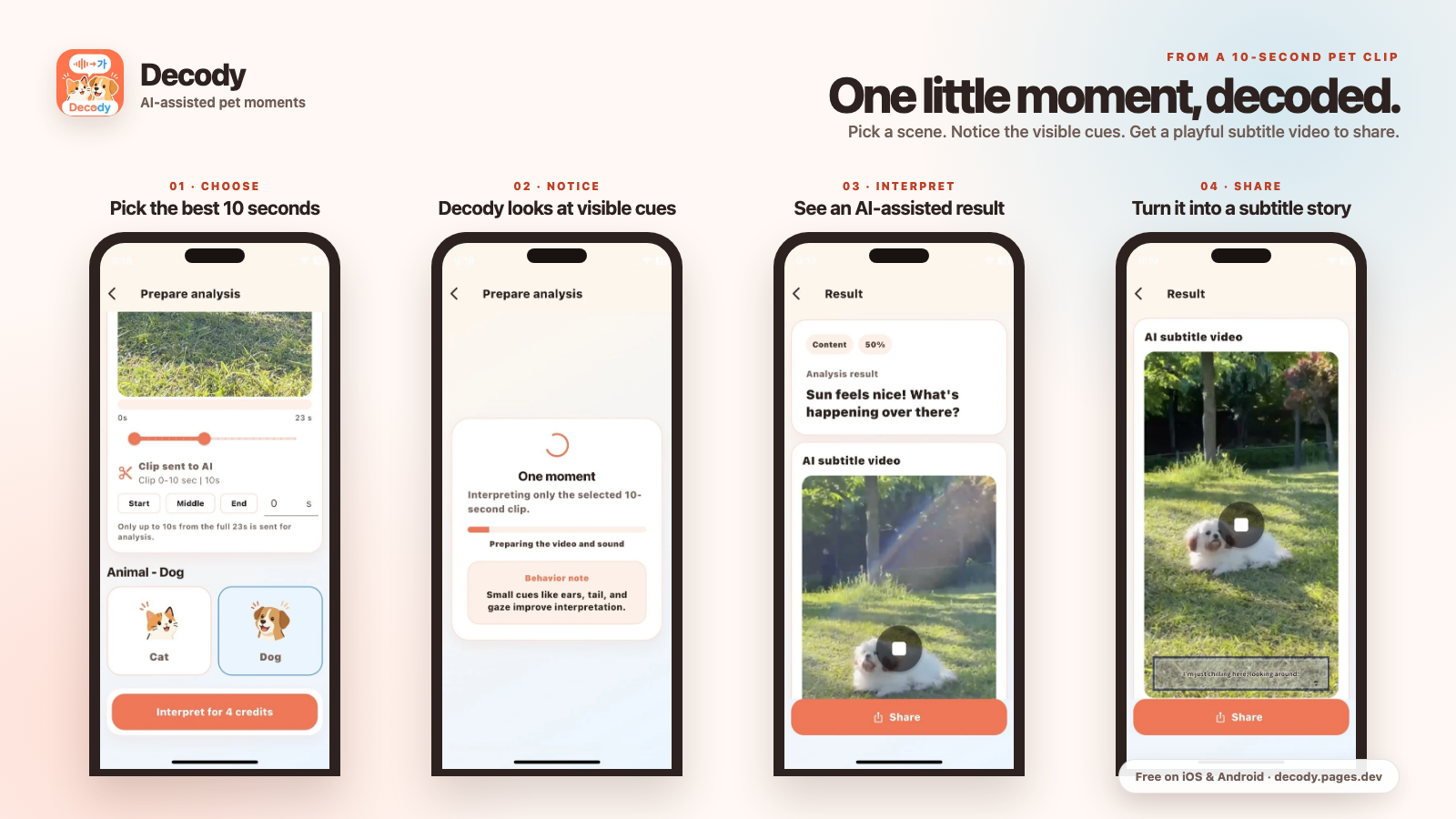
The launch taught a less glamorous lesson: AI can accelerate implementation, but the product still needs secrets kept off-device, rate limits, credit refunds after failed jobs, purchase reconciliation, accurate store screenshots, safety language and real-device testing.
How I built Decody from Flutter to Google Play and the App Store
Developer disclosure: I built Decody and may benefit from installs or purchases. It is for pet-owner curiosity and entertainment, not veterinary diagnosis or literal animal translation.
More field notes are on the way
I am publishing the cost, closed-testing and monetization notes one at a time after a final fact check. The next guide is scheduled for 17 August.


Comments
Post a Comment