AdMob vs IAP vs Subscriptions in India: A Practical Guide
There is no universally best monetization model for an Indian Android app. Use ads when many users repeat a free task, a one-time purchase when one durable unlock creates the value, consumable credits when each job creates a new cost, and a subscription only when users receive continuing value.

- Banner/interstitial ads: broad, frequent free use where an interruption will not damage the task.
- Rewarded ads: a user voluntarily exchanges attention for a clearly stated in-app reward.
- One-time purchase: a lasting unlock such as export, pro tools or ad removal.
- Consumable credits: repeated cloud, AI or media work with a cost per job.
- Subscription: recurring service, content, storage, monitoring or quota.
Why India changes the calculation
India offers enormous mobile reach, but reach and revenue per user are not the same thing. Sensor Tower estimated 6.2 billion app downloads in India during Q1 2026. Non-gaming apps represented 72% of downloads, while total in-app purchase revenue exceeded US$300 million and grew 33% year over year. Generative-AI app downloads grew 69% year over year.
Those figures show demand and improving monetization, not an easy payout for every app. A small developer still needs local pricing, trustworthy onboarding, low data usage, good performance on varied devices and a reason to return. An ad impression from a low-value session cannot rescue a product that users never open twice.
The practical decision table
| Model | Best fit | Main metric | Common failure |
|---|---|---|---|
| Display/interstitial ads | High-frequency free entertainment or utility sessions | Revenue per active user without retention loss | Showing an ad before value or interrupting the core action |
| Rewarded ads | Optional extra lives, credits or temporary access | Opt-in completion and reward delivery | Coercive choice, unclear reward or failed grant |
| One-time purchase | Offline or durable pro feature | Trial-to-purchase conversion and refund rate | Charging repeatedly for value that is delivered once |
| Consumable credits | AI, rendering, media processing or other metered jobs | Contribution margin per completed job | Losing credits on failures or hiding the usage rule |
| Subscription | Ongoing cloud service, fresh content, storage or monitoring | Paid retention, churn and support cost | Recurring price without recurring value |
AdMob: start after value, not before it
Ads have the lowest payment friction, which makes them tempting for a new app. They also create a direct conflict with user attention. A full-screen ad at launch or before the first useful result can reduce the very retention needed to create future impressions.
A rewarded ad is usually easier to explain because the exchange is explicit. Google’s policy requires a clear, accurate disclosure of the action and reward. Except for the rewarded-interstitial format, the user must affirmatively opt in. Skipping the ad must not interfere with normal use, and the promised non-transferable in-app reward must be delivered.
Use this rewarded-ad checklist
- State exactly what the user receives before the ad appears.
- Provide a genuine “not now” path.
- Do not disguise the button or claim the ad “supports us” to push a choice.
- Grant the reward only once and make the process retry-safe.
- Track ad completion separately from successful reward delivery.
- Keep the core app usable without forced rewarded-ad participation.
One-time purchases: the cleanest model for a durable unlock
A one-time purchase fits when the user can understand the permanent benefit in one sentence: remove ads, export without a watermark, unlock advanced filters or enable an offline tool. It avoids subscription fatigue and creates a simple product promise.
It fits poorly when every use creates a server bill. If a user pays once for “unlimited AI analysis,” the developer carries an uncapped future cost. A fair alternative is to sell a durable pro feature separately from metered processing.
Consumable credits: align revenue with variable work
Credits can make sense for AI and media products because each completed job consumes compute or provider capacity. They are not automatically user-friendly. The app must show the cost before the action, reserve the credit safely, return it on a failed job and reconcile store purchases on a trusted server.
Subscriptions: charge for the service that continues
A subscription is justified by continuing value: new quota, cloud sync, active monitoring, fresh content, ongoing support or a service that must stay online. “We want monthly revenue” is not value from the user’s perspective.
Before adding a subscription, write the cancellation sentence first: If the user cancels today, what ongoing service stops? If the answer is unclear, the product may need a one-time purchase or credits instead.
The Decody hybrid: why one model was not enough
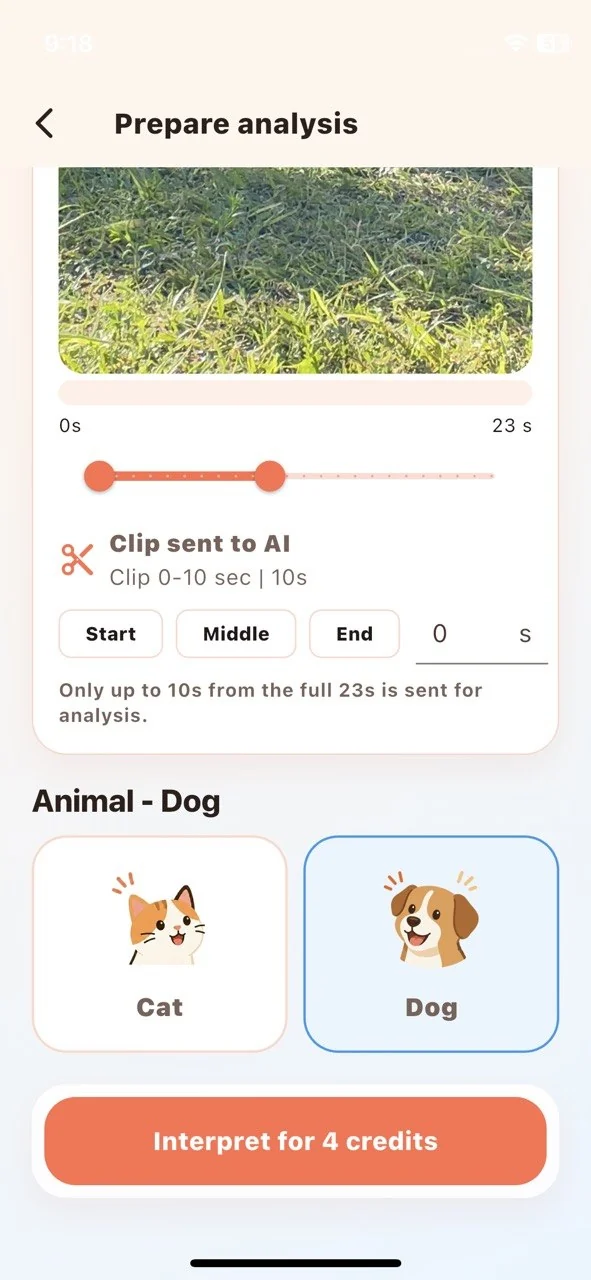
Decody processes a selected ten-second pet clip and returns an AI-assisted interpretation plus a shareable result. The product combines several cost shapes:
- The app and basic exploration should be easy to try.
- Each media analysis creates variable backend and AI work.
- A rewarded ad can grant an optional in-app benefit.
- Credit packs can support occasional users.
- A recurring plan can serve users who receive recurring quota and service.
The important architecture is not the paywall screen. It is the server-owned credit ledger, purchase verification, repeat-safe webhook handling and refund path. A number stored only on the phone is not a trustworthy balance.

Calculate contribution, not just gross revenue
Monthly contribution
ad revenue + purchase proceeds + subscription proceeds − store/billing fees − backend/AI cost − refunds − support and acquisition cost
Use proceeds after the applicable store and billing fees, not the price displayed to the customer. Google says service fees vary by program, transaction and region; there is no single rate for every developer.
For a metered AI action, calculate one level deeper:
contribution per completed job = allocated net revenue − provider cost − compute/storage − expected refund and failure cost
If that number is negative before marketing, more downloads increase the loss. Fix the model, price, limits or processing path first.
A 30-day monetization test
- Days 1–7: measure the free loop. Track first useful action, completion, errors and return visits. Do not add more paywalls to compensate for poor activation.
- Days 8–14: test one offer. Pick the model most aligned with the product. Keep the price and benefit clear.
- Days 15–21: inspect quality. Compare conversion with retention, refunds, failed rewards, support messages and provider cost.
- Days 22–30: keep or remove. Expand only if the offer adds positive contribution without damaging the useful loop.
Do not test five monetization changes at once. You will know that revenue moved but not why.

Continue the build-to-revenue path
- How I built Decody from Flutter UI to public stores
- The real Google Play launch budget in India
- The 12-testers-for-14-days closed-testing guide
I am the developer of Decody. It is available for Android and iOS and is intended for pet-owner curiosity and entertainment—not diagnosis or literal animal translation.
Sources
- Sensor Tower: India mobile app market, Q1 2026
- Sensor Tower: State of India Mobile App Market 2026
- Google AdMob rewarded-ad policies
- Google Play service fees
Disclosure: I develop Decody and may benefit if a reader installs or purchases through its store listing. This article is an educational product-analysis framework, not financial advice or a revenue guarantee.


Comments
Post a Comment